
Picture this: you've just been told your ISO certification audit is scheduled for three months from now. Your stomach drops. You're wondering if that's enough time to get everything sorted, or if you're about to face an expensive failure that could derail important contracts.
Here's the truth: How to Prepare for Your ISO Certification Audit (90-Day Plan) is absolutely achievable—but only if you approach it systematically and honestly assess where you're starting from. We've guided hundreds of organisations through this exact scenario, and whilst it requires focused effort, it's far from impossible when you know what actually matters to auditors.
Key Takeaways
• 90-day preparation is realistic when you have basic management systems already in place—not when you're starting from scratch
• The three phases approach works: Days 1-30 for foundation and gap analysis, Days 31-60 for implementation and training, Days 61-90 for testing and evidence gathering
• Stage 1 and Stage 2 audits are separate events, typically occurring 30-60 days apart, giving you breathing room between assessments
• Internal auditing and management review must be completed and showing real results before your certification audit
• Document everything as you go—auditors need evidence of your system working in practice, not just policies gathering dust
Understanding the 90-Day Reality Check
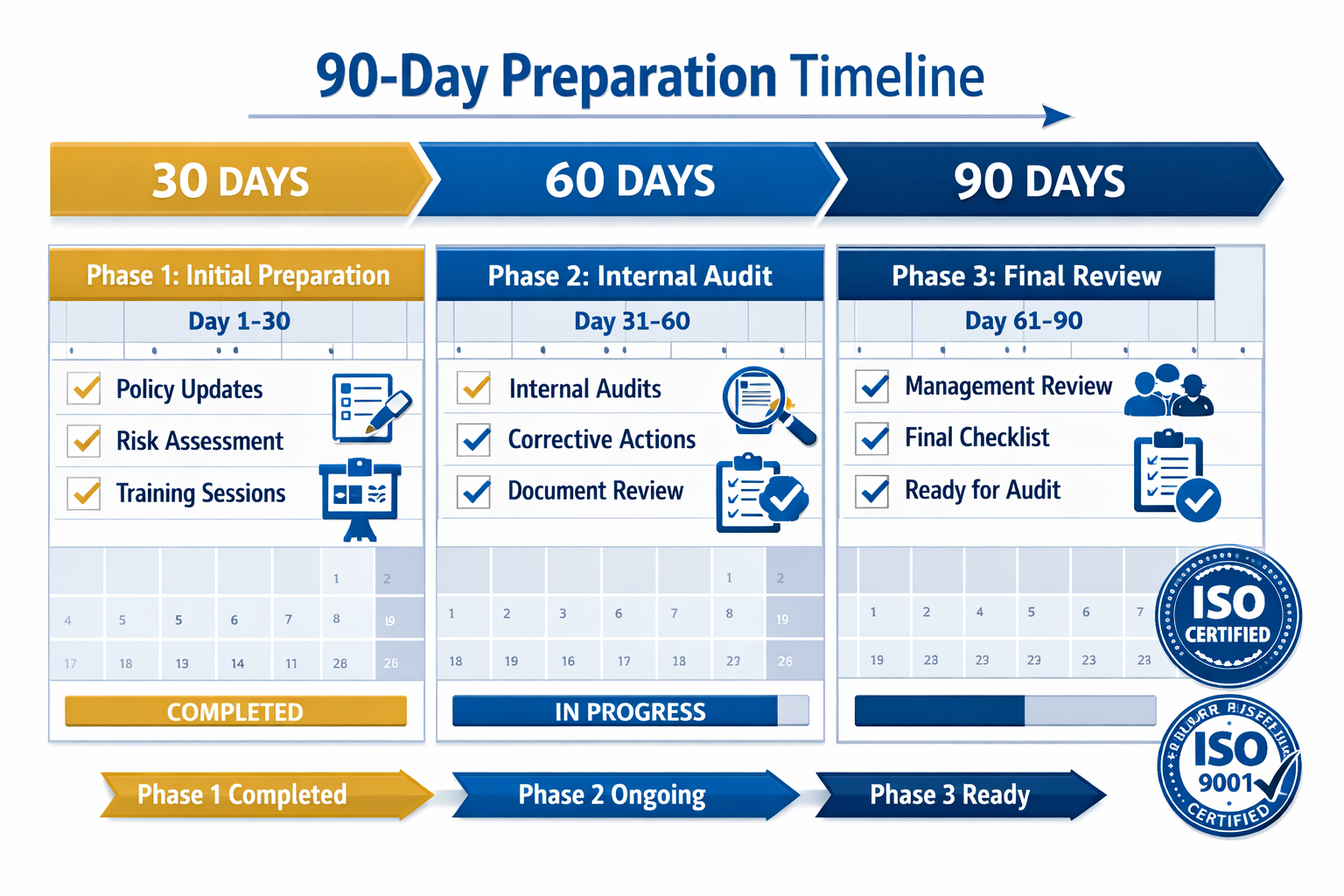
Let's be honest about what makes a 90-day preparation timeline realistic versus wishful thinking. Recent guidance from quality management experts shows that organisations can achieve audit-ready status within this timeframe, but there are specific conditions that must be met.
You're in good shape for 90 days if you have:
- Basic organisational structure and defined roles
- Some existing procedures (even if they're not ISO-compliant)
- Management commitment and dedicated resources
- Previous experience with quality systems or compliance
You'll need longer than 90 days if:
- You're building everything from scratch
- Management support is lukewarm
- You can't dedicate at least 0.5-1 FTE to the project
- Your organisation has never dealt with formal management systems
The reality is that most organisations follow a 6-12 month implementation timeline. The 90-day approach is an accelerated path that works when you've got the right foundation and commitment.
Phase 1: Days 1-30 - Foundation and Gap Analysis
Your first 30 days determine whether the rest of your timeline is realistic or fantasy. This phase is about understanding exactly where you stand and what needs to happen.
Week 1-2: Scope Definition and Initial Assessment
Start with brutal honesty about your current state. You need to define exactly what your ISO certification will cover—which locations, which processes, which standards. Don't try to boil the ocean here.
Critical first steps:
- Map your current processes (even informal ones)
- Identify who's responsible for what
- Document your existing quality controls
- List all the procedures you know you're missing
Sound familiar? Most organisations discover they're doing more than they thought—it's just not documented in a way that satisfies ISO requirements.
Week 3-4: Formal Gap Analysis and Planning
This is where you get scientific about what's missing. A proper gap analysis compares your current practices against the specific ISO standard requirements. Don't skip this step—it's the difference between focused effort and expensive trial-and-error.
What you're looking for:
- Procedures that exist but aren't documented
- Required processes that don't exist at all
- Documentation that exists but isn't being followed
- Training gaps across your team
By day 30, you should have a detailed action plan that breaks down exactly what needs to be created, modified, or improved. If this list looks overwhelming, that's your signal that 90 days might not be realistic for your situation.
Phase 2: Days 31-60 - Implementation and Training
Here's where the real work happens. You're building and implementing the management system that auditors will assess. This isn't about creating impressive documents—it's about creating systems that actually work in your organisation.
Building Your Management System
Your ISO implementation needs to focus on procedures that solve real business problems, not just tick compliance boxes. Whether you're pursuing ISO 9001 for quality management, ISO 14001 for environmental management, or ISO 45001 for health and safety, the principle remains the same: build systems that make business sense.
Key implementation priorities:
- Document control system: How you manage versions, approvals, and distribution
- Training matrix: Who needs to know what, and how you'll prove they know it
- Record keeping: What records you'll keep and how long you'll keep them
- Internal communication: How information flows through your organisation
Staff Training and Competency
Training isn't about running everyone through a generic ISO awareness session. It's about ensuring people understand their specific roles in the management system and can demonstrate competency when auditors ask questions.
Effective training approach:
- Role-specific training based on actual job functions
- Practical exercises using your new procedures
- Competency assessments that prove understanding
- Documentation of all training activities
By day 60, your team should be operating under the new system and generating real records. This is crucial—auditors want to see evidence that your system works in practice, not just on paper.
Phase 3: Days 61-90 - Testing and Evidence Gathering
The final 30 days are about proving your system works and gathering the evidence auditors will want to see. This phase separates organisations that pass first time from those that face expensive non-conformities.
Internal Auditing Programme
Your internal audit isn't a box-ticking exercise—it's your chance to identify problems before external auditors do. You need at least one complete internal audit cycle covering all areas of your scope.
Internal audit essentials:
- Trained internal auditors (can be external consultants initially)
- Audit against the actual ISO standard requirements
- Document all findings, including minor issues
- Implement corrective actions for any non-conformities
- Follow up to verify corrections are effective
Management Review Process
Management review proves that senior leadership is actively involved in the management system. This isn't a one-off meeting—it's a formal process that demonstrates management commitment and drives continual improvement.
Management review must cover:
- Internal audit results and corrective actions
- Customer feedback and complaints
- Performance against objectives
- Resource requirements and allocation decisions
- Opportunities for improvement
Preparing for Stage 1 Audit
The certification process involves two separate audits. Stage 1 is a documentation review that typically occurs 30-60 days before Stage 2. Use this as a dress rehearsal for the main event.
Stage 1 preparation:
- Complete management system documentation
- Evidence of system operation (records, training records, audit results)
- Demonstration that processes are working as documented
- Corrective action records showing continuous improvement
Remember, you have up to 60 days to correct any non-conformities identified during assessment, but it's far better to get things right first time.
Making Your 90-Day Plan Work
Success with this timeline requires honest assessment, dedicated resources, and realistic expectations. Here's what actually makes the difference:
Resource commitment: You need someone dedicated to this project, whether internal staff or external consultants. Trying to fit ISO preparation around everyone's day job is a recipe for delays.
Management support: Leadership must be visibly committed, not just paying lip service. Auditors will ask employees about management involvement, and the answers need to be genuine.
Focus on your scope: Don't try to certify everything at once. Start with core processes and expand later if needed.
Use expert help wisely: Whether through ISO training or ongoing support, expert guidance can accelerate your timeline significantly.
Conclusion
How to Prepare for Your ISO Certification Audit (90-Day Plan) is demanding but achievable when you have the right foundation and approach it systematically. The three-phase structure—foundation and gap analysis, implementation and training, testing and evidence gathering—provides a proven roadmap that hundreds of organisations have followed successfully.
The key is honest assessment from day one. If you're starting with basic systems and committed resources, 90 days can work. If you're building from scratch or fighting for management attention, extend your timeline rather than setting yourself up for failure.
Your next steps:
- Complete an honest gap analysis against your chosen ISO standard
- Secure dedicated resources for the project
- Create a detailed 90-day project plan with weekly milestones
- Consider expert support to accelerate critical phases
- Schedule your Stage 1 audit for day 75-80, allowing buffer time for corrections
Remember, certification isn't the finish line—it's the starting point for ongoing improvement. Build systems that work for your business, not just for auditors, and you'll find the ongoing maintenance far more manageable.