You're staring at a tender deadline, and there it is again—that dreaded requirement for ISO certification. The contract's worth six figures, but you need certification in three months. Your first thought? "Impossible." Your second? "Maybe there's a way."
Here's the truth: can you get ISO certified in 3 months? Yes, but it depends entirely on your starting point, the standard you're pursuing, and how much effort you're willing to invest. We've seen small, focused organisations achieve this timeline, whilst others need twice as long.
Key Takeaways
• Small organisations with simple operations can achieve ISO certification in 1-3 months with dedicated resources and expert guidance
• Your current compliance level matters more than company size—existing quality systems dramatically reduce implementation time
• ISO 27001 and ISO 9001 are most suitable for 3-month timelines, whilst technical standards like ISO 17025 require 6-12 months minimum
• Gap analysis is your reality check—it reveals whether 3 months is realistic for your specific situation
• Success requires full commitment—half-hearted efforts stretch timelines to 6-12 months regardless of company size
What Actually Determines Your ISO Certification Timeline?
Let's be honest—most online articles give you woolly timelines like "3-12 months" without explaining what puts you at either end of that range. Here's what actually matters:
Your Starting Point
If you're already following structured quality processes, you're ahead of the game. Organisations with existing compliance frameworks can often achieve certification in the shorter timeframes. But if you're starting from scratch with no documented procedures? You're looking at the longer end.
Which Standard You're Pursuing
Not all ISO standards are created equal. Small organisations can achieve ISO 27001 certification in 3 months when they have committed resources and simpler operations. ISO 9001 follows similar timelines for focused businesses. However, technical standards like ISO 17025 require 6-12 months minimum due to accreditation complexity.
Resource Commitment
This isn't about company size—it's about dedication. A 20-person business that commits proper time and resources will outpace a 200-person company where ISO gets pushed to the bottom of everyone's priority list.
Expert Guidance
We've seen businesses waste months going in circles without proper guidance. Professional ISO consultancy services don't just speed things up—they prevent costly mistakes that reset your timeline.
The Reality of 3-Month ISO Certification Timelines
Sound familiar? You need certification fast, but every consultant gives you different timelines. Here's what actually happens when organisations attempt 3-month certification:
Who Actually Achieves 3-Month Certification?
Small, Focused Operations
Businesses with under 50 employees, single locations, and straightforward processes have the best chance. We're talking about professional services firms, small manufacturers with standard processes, or tech companies with defined workflows.
Organisations with Existing Systems
If you're already following quality management principles—even informally—you're months ahead of competitors starting from zero. Pre-existing compliance systems significantly accelerate timelines.
Businesses with Dedicated Project Teams
This means someone (or several people) treating ISO implementation as their primary job for three months. Not something they'll "fit in around other work."
What Makes 3 Months Unrealistic?
Complex Multi-Site Operations
Multiple locations mean multiple implementations, multiple teams to train, and multiple audits to coordinate. Each additional site typically adds 2-4 weeks to your timeline.
Heavily Regulated Industries
If you're already managing compliance with industry-specific regulations, adding ISO creates integration challenges that extend timelines.
Resource Constraints
When ISO becomes everyone's second priority, 3-month timelines become 12-month slogs. We've seen it happen repeatedly.
Breaking Down the 3-Month Certification Process
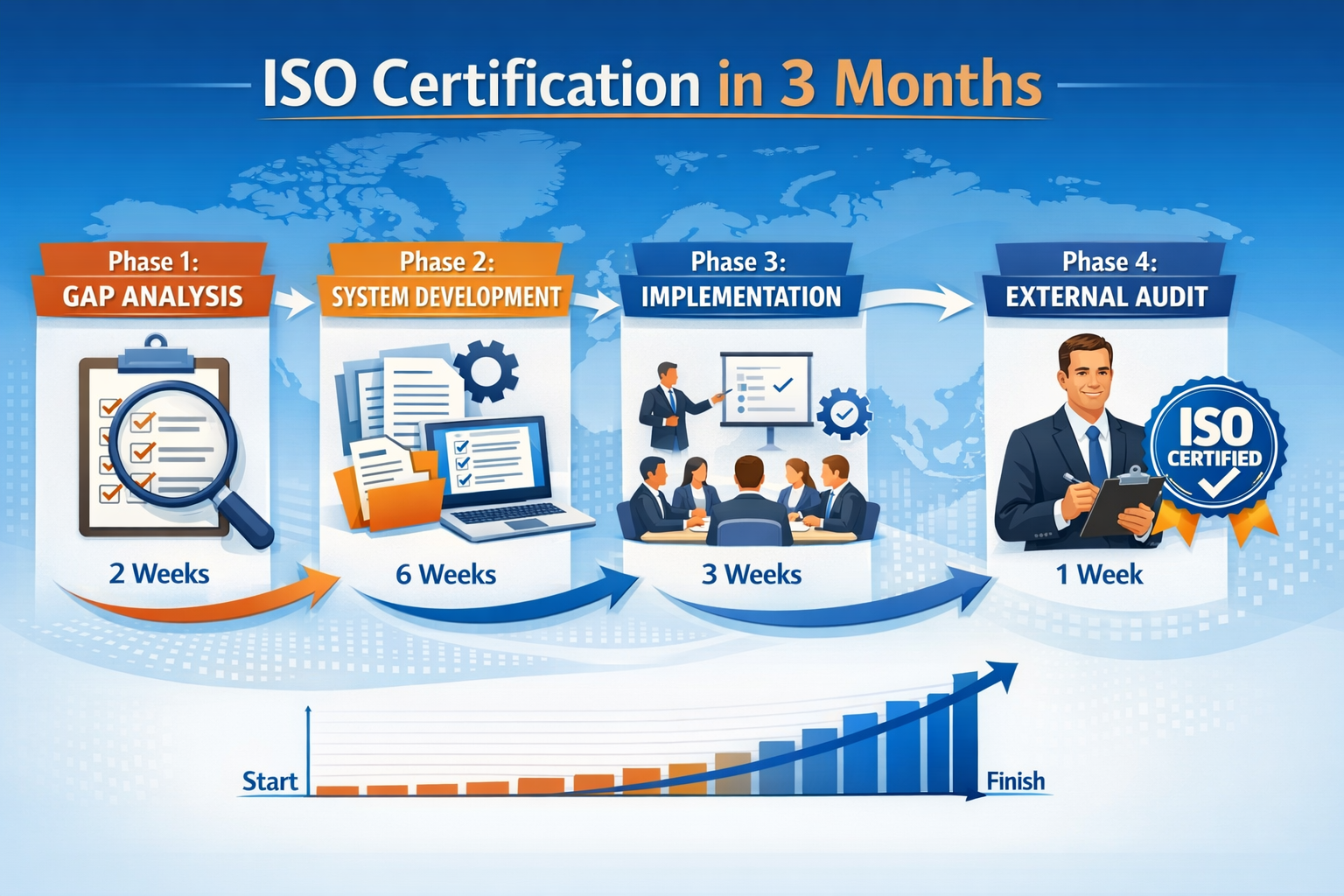
Here's how the 3-month timeline actually works when everything goes right:
Phase 1: Gap Analysis (Weeks 1-2)
Your gap analysis compares current systems against ISO requirements. This critical first step takes 2-4 weeks and identifies exactly what you're missing.
No sugar-coating here—if the gap analysis reveals major deficiencies, your 3-month timeline just became 6 months. Better to know now than discover it during your external audit.
Phase 2: System Development and Documentation (Weeks 3-8)
This is where most of your effort goes. You're building procedures, work instructions, and quality manuals that actually reflect how your business operates. System development and documentation requires 2-3 months in most cases.
The trick? Don't over-engineer. We see businesses creating 200-page quality manuals when 50 pages would suffice. Your ISO implementation support should focus on what's necessary, not what's impressive.
Phase 3: Implementation and Internal Audit (Weeks 9-11)
Now you're actually following your new procedures and testing whether they work in practice. Implementation and internal audit phases take 2-4 months typically, but focused organisations can compress this to 2-3 weeks.
This phase reveals whether your documentation matches reality. If not, you're back to Phase 2 for revisions.
Phase 4: External Assessment (Week 12)
The final external assessment and accreditation requires 1-2 months, but the actual audit happens over just a few days. The timeline depends on auditor availability and any corrective actions needed.
Which ISO Standards Support 3-Month Timelines?
Not all standards are equal when you're racing against the clock:
ISO Standards Suitable for 3-Month Certification
ISO 9001 (Quality Management)
ISO 9001 certification works well for 3-month timelines because it focuses on management processes rather than technical requirements. Small businesses with existing quality awareness often achieve this quickly.
ISO 27001 (Information Security)
ISO 27001 certification explicitly supports 3-month timelines for smaller, committed organisations, though the general range is 3-12 months. Tech companies often find this standard aligns with existing security practices.
ISO 45001 (Health and Safety)
ISO 45001 certification can work for 3-month timelines when businesses already follow health and safety protocols. Construction and manufacturing companies with strong safety cultures adapt quickly.
Standards That Don't Support 3-Month Timelines
ISO 17025 (Testing and Calibration)
This technical standard requires 6-12 months minimum due to accreditation complexity. The technical competence requirements simply can't be rushed.
ISO 13485 (Medical Devices)
ISO 13485 certification involves regulatory compliance that extends timelines significantly. Medical device companies need 6-12 months typically.
Maximising Your Chances of 3-Month Success
Want to actually hit that 3-month target? Here's what works:
Start with Honest Assessment
Book a proper gap analysis before committing to timelines. It costs a few thousand pounds but saves months of wasted effort. Most businesses overestimate their readiness and underestimate the work required.
Invest in Expert Guidance
Professional consultants don't just provide templates—they prevent the mistakes that reset timelines. We've seen DIY approaches take 18 months to achieve what professional guidance delivers in 4 months.
Commit Proper Resources
Assign dedicated project team members, not people fitting ISO "around other work." This isn't optional if you want 3-month timelines.
Focus on Integration
Don't build ISO systems alongside existing processes—integrate them. The businesses that succeed quickly make ISO part of how they already work, not additional bureaucracy.
What Happens After Certification?
Here's what nobody tells you: certification isn't permanent. You'll need ongoing ISO maintenance through annual surveillance audits and full re-certification every three years.
Plan for this from day one. The businesses that treat certification as a one-time project struggle with maintenance. Those that build sustainable systems find ongoing compliance straightforward.
Conclusion
Can you get ISO certified in 3 months? Absolutely—if you're a small, focused organisation with existing quality processes, dedicated resources, and expert guidance. We've seen it happen repeatedly with ISO 9001 and ISO 27001 implementations.
But here's the reality check: most businesses need 6-12 months because they underestimate the work required or lack proper support. Don't let optimistic timelines cost you that contract—get a professional gap analysis first.
Ready to explore your 3-month certification options? Contact our team for an honest assessment of your timeline. We'll tell you whether 3 months is realistic for your situation—and exactly what it'll take to get there.