You've been told you need ISO 9001 certification to win that contract, keep that client, or satisfy that tender requirement. Now you're wondering: how long is this going to take? The honest answer about how long ISO 9001 certification takes depends on your starting point, resources, and how seriously you approach the process.
Here's the reality: most businesses achieve ISO 9001 certification within 4 to 18 months. That's a wide range because every organisation is different. Some have quality systems already in place; others are starting from scratch. Some dedicate proper resources; others try to squeeze it in around everything else.
Let's break down what actually determines your timeline and give you realistic expectations for your situation.
Key Takeaways
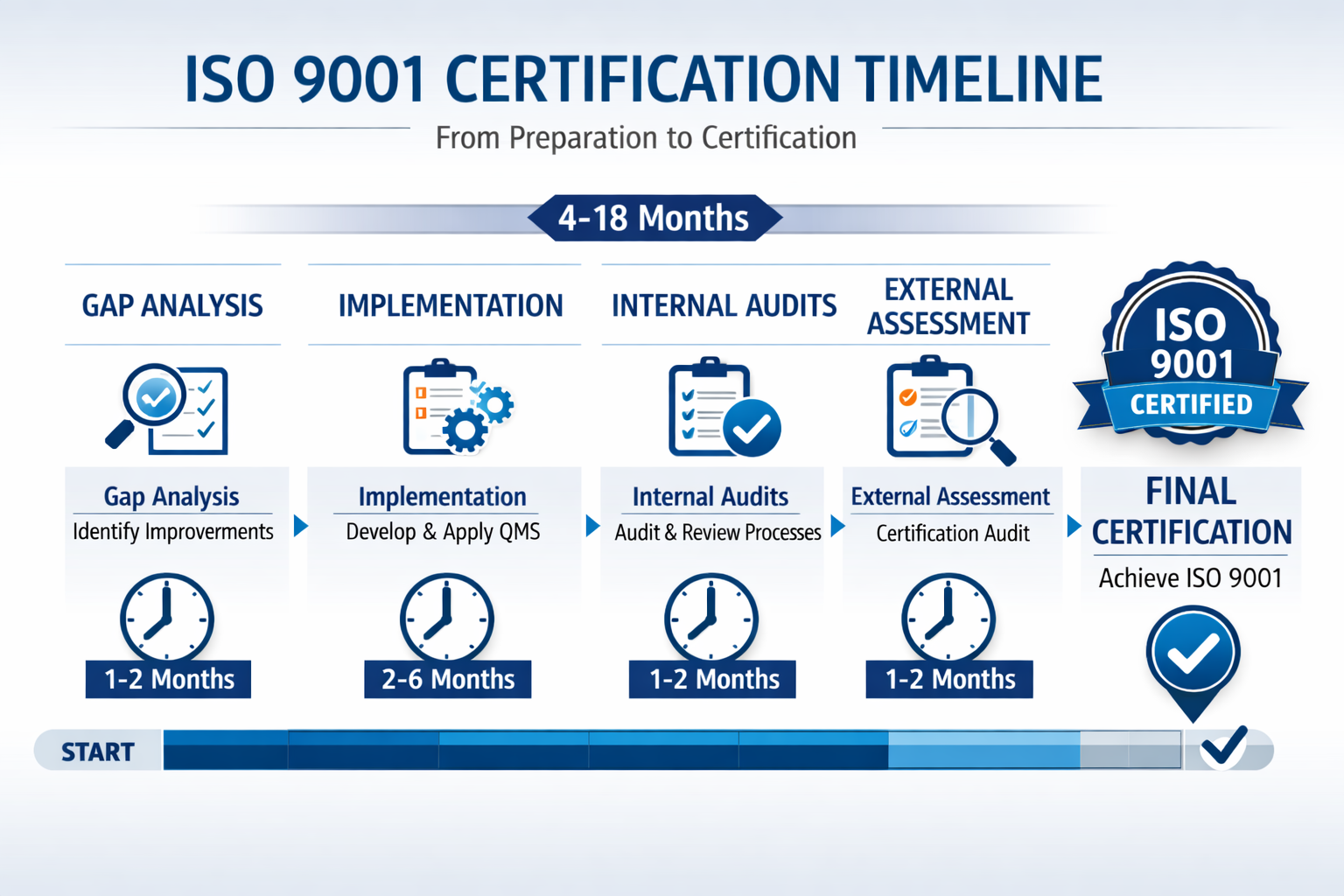
• Typical timeframe: 4-18 months from start to certification, with most businesses completing the process in 6-12 months
• Preparation phase: 2-6 months for gap analysis, system development, and implementation
• Assessment phase: 2-4 months for Stage 1 audit, corrections, and final Stage 2 certification audit
• Key factors: Your existing quality systems, available resources, business complexity, and commitment level significantly impact duration
• Fast-track option: Businesses with existing quality processes and dedicated resources can achieve certification in 4-6 months
Understanding the ISO 9001 Certification Process
Before we dive into timelines, you need to understand what you're actually committing to. ISO 9001 certification isn't just filling out some forms and booking an audit. It's building a quality management system that demonstrates you consistently deliver products and services that meet customer requirements.
The certification process follows a fixed sequence:
Gap Analysis → System Development → Implementation → Internal Auditing → Management Review → External Assessment
You can't skip stages or rush through them without consequences. Each phase builds on the previous one, and auditors will spot shortcuts immediately.
The Two-Stage Audit Process
External certification involves two mandatory audits:
- Stage 1 Audit: Document review and readiness assessment
- Stage 2 Audit: Full certification assessment of your implemented system
There's typically a 4-8 week gap between these audits, which you can't compress. This alone adds 2-3 months to your timeline once you're ready for external assessment.
Factors That Determine How Long ISO 9001 Certification Takes
Your Starting Point
If you already have quality processes: You might have procedures, work instructions, and quality controls in place. Lucky you. This can cut months off your timeline because you're enhancing existing systems rather than building from scratch.
If you're starting from nothing: Expect the longer end of the timeline range. You'll need to develop processes, train staff, and embed new ways of working. This takes time—there's no way around it.
Business Complexity
A single-site consultancy with five staff will achieve certification faster than a multi-site manufacturer with complex supply chains. That's obvious, but here's what people don't consider:
- Number of processes: More processes mean more documentation and more things to audit
- Regulatory requirements: Heavily regulated industries need more comprehensive systems
- Customer variety: Serving different customer types often requires more complex quality controls
- Geographic spread: Multiple locations multiply the implementation effort
Resource Allocation
This is where most businesses trip up. You're probably thinking you can squeeze ISO 9001 implementation around everyone's day job. You can't. Not if you want to achieve certification efficiently.
Dedicated project management: Businesses that assign someone to drive the project complete certification 30-40% faster than those where it's everyone's side project.
Senior management engagement: When leadership actively supports the project, things move. When they just pay lip service, everything takes longer.
External support: Working with experienced ISO consultants typically halves implementation time. We know what works, what doesn't, and how to avoid the common pitfalls that derail projects.
Realistic Timeline Breakdown
Phase 1: Gap Analysis and Planning (2-4 weeks)
Before you do anything else, you need to understand exactly what you're dealing with. A proper gap analysis compares your current processes against ISO 9001 requirements.
This phase involves:
- Current state assessment: What quality processes already exist?
- Requirement mapping: What does ISO 9001 actually require for your business?
- Implementation planning: What needs to be developed, changed, or documented?
Time-saving tip: Don't skip this phase to save time. Businesses that rush into implementation without proper gap analysis invariably take longer overall because they're working blind.
Phase 2: System Development (1-3 months)
Now you're building your quality management system. This includes:
Documentation development:
- Quality manual (if you choose to have one)
- Procedures for key processes
- Work instructions where needed
- Forms and templates
Process design:
- Customer communication processes
- Design and development controls (if applicable)
- Purchasing and supplier management
- Production and service provision controls
- Monitoring and measurement processes
Training material creation:
- Staff awareness training
- Role-specific training for key personnel
- Internal auditor training
The complexity of your business directly impacts this timeline. A simple service business might complete system development in 4-6 weeks. A manufacturer with design responsibilities could need 3-4 months.
Phase 3: Implementation and Embedding (2-6 months)
Having procedures on paper means nothing. You need to implement them, train your team, and prove they work in practice. This is often the longest phase because it involves changing how people work.
What happens during implementation:
- Staff training on new procedures
- Process trials and refinements
- Data collection to demonstrate effectiveness
- Corrective actions for initial problems
- Management reviews to assess progress
Common timeline killers:
- Insufficient training leading to poor adoption
- Resistance to change from key staff
- Unrealistic procedures that don't work in practice
- Lack of management support when problems arise
Phase 4: Internal Auditing and Review (1-2 months)
Before external assessment, you need to audit your own system. This involves:
Internal audit programme:
- Training internal auditors
- Conducting comprehensive internal audits
- Addressing non-conformances found
- Management review of audit results
Pre-assessment preparation:
- Document control verification
- Evidence collection
- Staff briefing for external audit
- Final system checks
Many businesses underestimate this phase. You can't just tick boxes—internal audits need to be thorough because external auditors will scrutinise your internal audit effectiveness.
Phase 5: External Certification Assessment (2-4 months)
The final phase involves your chosen certification body:
Stage 1 Audit (Document Review):
- Typically 1-2 days depending on business size
- Focus on documentation adequacy
- Identification of any major gaps
- Planning for Stage 2 audit
Gap Period:
- Minimum 4 weeks between Stage 1 and Stage 2
- Time to address any Stage 1 findings
- Final preparation for certification audit
Stage 2 Audit (Certification Assessment):
- Comprehensive on-site assessment
- Interviews with staff at all levels
- Evidence review and process observation
- Certification decision
Certificate Issuance:
- Typically 2-4 weeks after successful Stage 2 audit
- Time for certification body internal review
- Certificate production and dispatch
Industry-Specific Considerations
Different industries face different challenges that affect certification timelines:
Manufacturing Businesses
Manufacturing companies typically need 8-12 months for certification because they're dealing with:
- Complex production processes
- Extensive supplier networks
- Product design and development requirements
- Calibration and measurement systems
Service Businesses
Professional service firms often achieve certification faster (4-8 months) because:
- Fewer physical processes to control
- Less complex supply chains
- Focus on customer satisfaction and service delivery
- Simpler measurement and monitoring requirements
Construction Companies
Construction businesses face unique challenges:
- Project-based operations
- Subcontractor management
- Site-specific quality controls
- Variable customer requirements
Expect 6-10 months for construction industry certification.
Technology Companies
Tech businesses often have advantages:
- Existing process documentation
- Quality-focused culture
- Good document control systems
- Measurement and analysis capabilities
Technology companies typically achieve certification in 4-8 months, especially if they're already following software development methodologies.
How to Accelerate Your ISO 9001 Certification Timeline
Start with Proper Planning
Conduct a thorough gap analysis: Understanding exactly what you need to do prevents false starts and rework.
Set realistic milestones: Break the project into manageable phases with clear deliverables.
Allocate adequate resources: Assign dedicated project management and ensure key staff have time for implementation activities.
Leverage Existing Systems
Build on what works: Don't reinvent processes that already deliver quality outcomes.
Integrate with current practices: ISO 9001 should enhance your business, not create parallel bureaucracy.
Use existing documentation: Adapt current procedures rather than starting from scratch.
Get Expert Help
Working with experienced ISO implementation consultants typically reduces certification time by 3-6 months. Here's why:
- Proven methodologies: We know what works and what wastes time
- Template libraries: Pre-built documentation frameworks speed development
- Training expertise: Efficient staff training and awareness programmes
- Audit preparation: Proper preparation prevents assessment delays
Avoid Common Delays
Over-documentation: More procedures don't mean better quality. Focus on what's actually needed.
Perfectionism: Your system needs to be effective, not perfect. You can refine it after certification.
Inadequate training: Invest properly in staff training to ensure smooth implementation.
Poor communication: Keep everyone informed about progress, changes, and expectations.
What About ISO 9001:2026?
Here's something most businesses don't know: ISO 9001:2026 is coming. The new version is targeted for publication in September-October 2026, with the Final Draft International Standard released in January 2026.
What this means for your timeline:
If you're starting certification now, you'll achieve certification to ISO 9001:2015. That's fine—you'll have a 2-3 year transition period to upgrade to the 2026 version.
However, there's an important consideration: certification bodies will need approximately one year (September 2026 to August 2027) to retrain auditors and complete accreditation for the new standard. This creates a potential bottleneck for businesses wanting early certification to ISO 9001:2026.
Our recommendation: Proceed with ISO 9001:2015 certification now. You'll have your certificate, can compete for contracts, and will transition to the 2026 version during your normal surveillance cycle.
The Real Cost of Delays
Let's be honest about what delayed certification actually costs:
Lost opportunities: Every month without certification potentially means missed tenders and lost contracts.
Extended consultant fees: Dragging out implementation increases professional service costs.
Staff frustration: Projects that overrun create cynicism and resistance to change.
Opportunity cost: Resources tied up in extended implementation can't be used for other business improvements.
Competitive disadvantage: Your competitors with certification are winning business while you're still implementing.
Making Your Decision
So, how long does ISO 9001 certification take? For most businesses, 6-12 months is realistic with proper planning and adequate resources.
You can achieve certification in 4-6 months if:
- You have existing quality systems
- You dedicate proper resources
- You get expert help
- Your business is relatively straightforward
Expect 12-18 months if:
- You're starting from scratch
- You have complex operations
- Resources are limited
- You're trying to do everything internally
The choice is yours, but remember: every day you delay starting is a day longer until you're certified. The businesses that succeed with ISO 9001 are those that commit properly to the process and see it through efficiently.
Ready to start? The first step is understanding exactly where you stand with a proper gap analysis. From there, you can build a realistic timeline that works for your business and gets you certified as quickly as possible.